The Aluminum Monthly Metals Index (MMI) trended up, rising 4.12% from December to January. Uptrends...
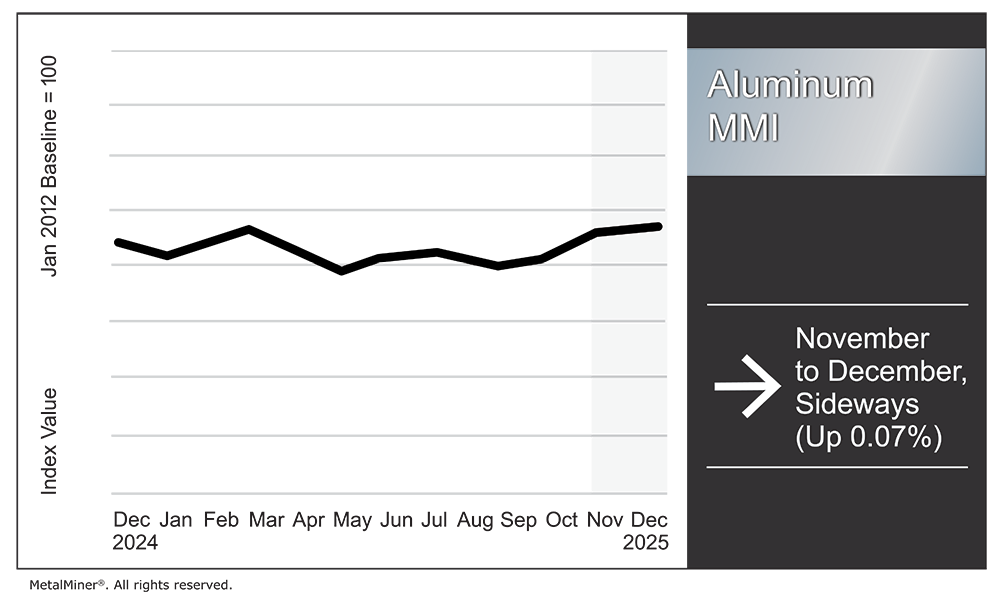
The Aluminum Monthly Metals Index (MMI) shifted sideways, rising by a mere 0.07% from November to December.
Midwest Premium Loses Momentum
The Midwest Premium spent more than a year in an almost uninterrupted uptrend. Since the close of 2024, the premium has jumped 245% as U.S. tariffs fueled an unprecedented rise. By mid-November, the premium appeared to have reached at least a short-term peak as the trend shifted sideways.
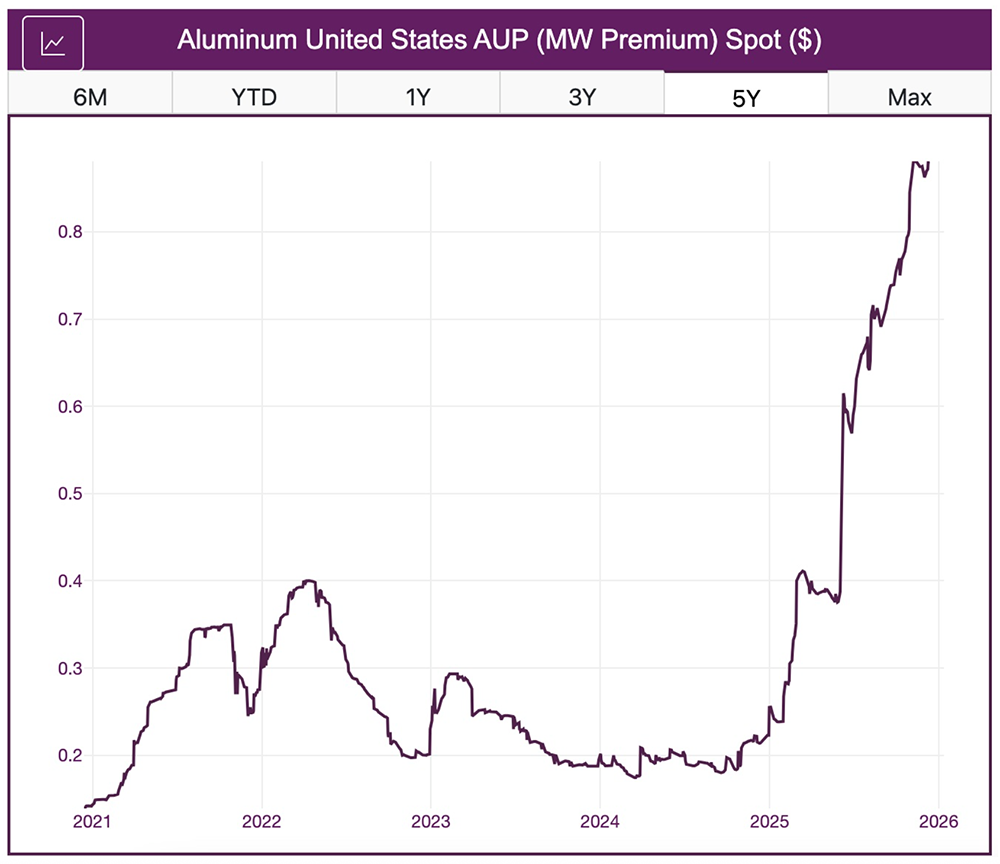
At its current level of around $0.88/lb, the premium has fully priced in tariff costs under current market conditions. This sentiment was echoed by Ryerson in its most recent financial report, which noted, “At recent Midwest premium pricing, tariff costs on U.S. imports of aluminum from Canada are fully covered by the Midwest premium.”
Absent a meaningful supply disruption or strong uptick in demand, which appears unlikely at present, this could mark the end of the uptrend.
2026 Aluminum Market Drivers
The 2026 U.S. aluminum market is gearing up for a year of major inflection points, with several powerful forces pulling the industry in different directions. New capacity additions and long-awaited restarts promise to reshape domestic supply, just as the explosive build-out of AI-driven data centers injects a fresh wave of demand, intensifying the nationwide battle for power. Layered on top of this are high-stakes trade negotiations that could rewrite the rules for how much aluminum enters the U.S., and at what cost.
Capacity
The U.S. capacity picture is set to change in 2026 as several large projects either restart or ramp up. From a primary perspective, Century Aluminum’s Mt. Holly smelter is executing a restart that the company says will bring the plant from ~75% to full production by June 30, 2026. The company estimates the resulting capacity jump will be roughly 50,000 tons, or an almost 10% boost to U.S. primary production. While this will benefit the U.S. market currently impacted by lower import volumes, energy prices will likely deter any significant growth of U.S. primary output.
At the same time, newer flat-rolled capacity from Aluminum Dynamics' Mississippi/Lowndes County mill is already shipping product amid its ongoing staged ramp-up, which will continue through 2026. This should help relieve supply tightness in automotive and industrial end markets.
Novelis is another major swing factor. The company’s Bay Minette greenfield rolling and recycling complex, a multi-billion-dollar project designed to expand U.S. rolled and recycled capacity, continues to progress. When it comes online sometime around the second half of the year, it will become a material incremental source of sheet/rolling capacity. Meanwhile, Novelis’ Oswego hot mill, which had been damaged by repeated fires, will also return. Its surprise shutdown had significant ramifications on the automotive sheet market.
Data Centers
Rapid data center construction for AI and cloud infrastructure is emerging as a major demand driver with complex implications for the aluminum market. Data centers require substantial amounts of aluminum for structural frames, cooling systems, cabling and other hardware, adding a new layer of consumption to an already stressed market. At the same time, the power demands of these facilities increase competition for electricity with energy-intensive aluminum smelters, potentially limiting the expansion of domestic production capacity.
Trade Deals
As the U.S. still relies on imports for much of its primary aluminum needs, changes in trade agreements or tariff levels can quickly alter supply availability and pricing dynamics. For instance, any deal with Canada is likely to include an adjustment to aluminum tariffs, whether through a quota or a reduced duty rate. For this reason, such a development remains a significant downside risk to the Midwest Premium. Meanwhile, the EU continues to push for a quota arrangement with the U.S. as well.
LME Prices Sideways as Funds Hold onto Long Bets
Exchange aluminum prices spent much of the recent period drifting sideways, mirroring the steadiness of the Midwest Premium. This comes even as the market tested, but failed to break through, the early-November LME highs. The broader uptrend that began in April has been powered largely by speculative momentum: investment funds piled into long positions and steadily backed away from shorts, giving prices a supportive floor even when physical signals were mixed.
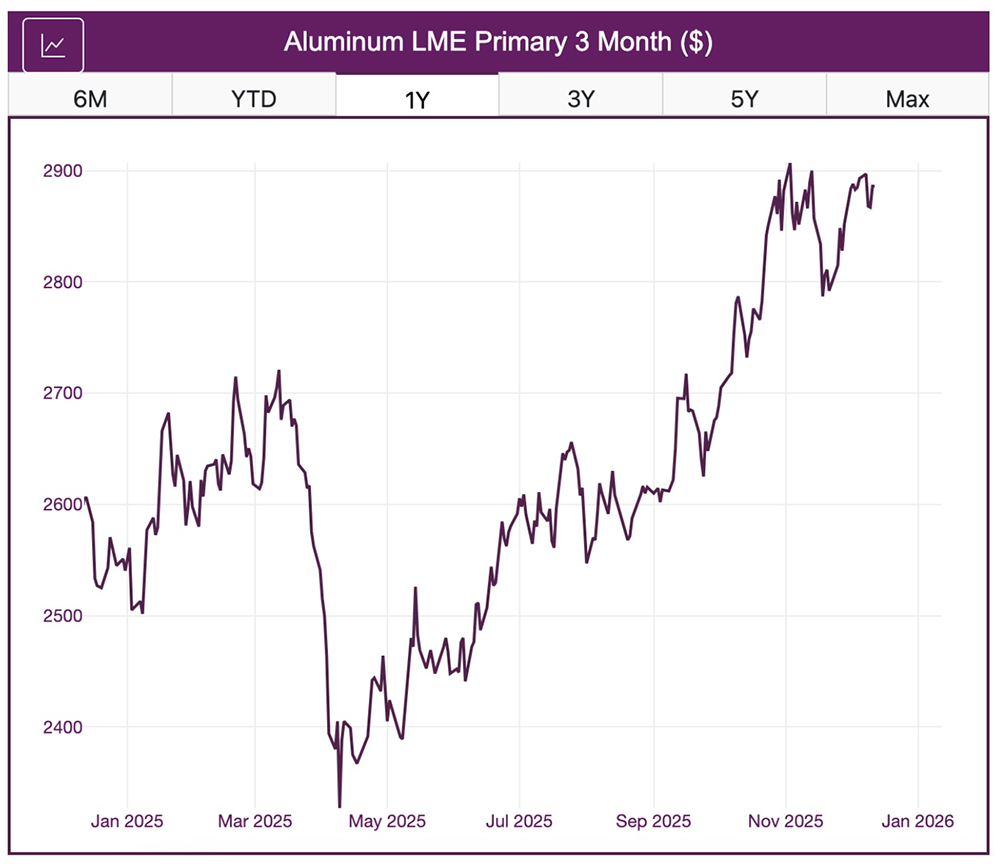
More recently, that bullish buildup has paused. But, notably, funds haven’t unwound their exposure. As of mid-December, they’re still holding onto those long positions, suggesting a market that’s cautious but far from turning bearish. This holding pattern reflects a wait-and-see stance as traders look toward upcoming supply shifts, power constraints and evolving macro conditions.
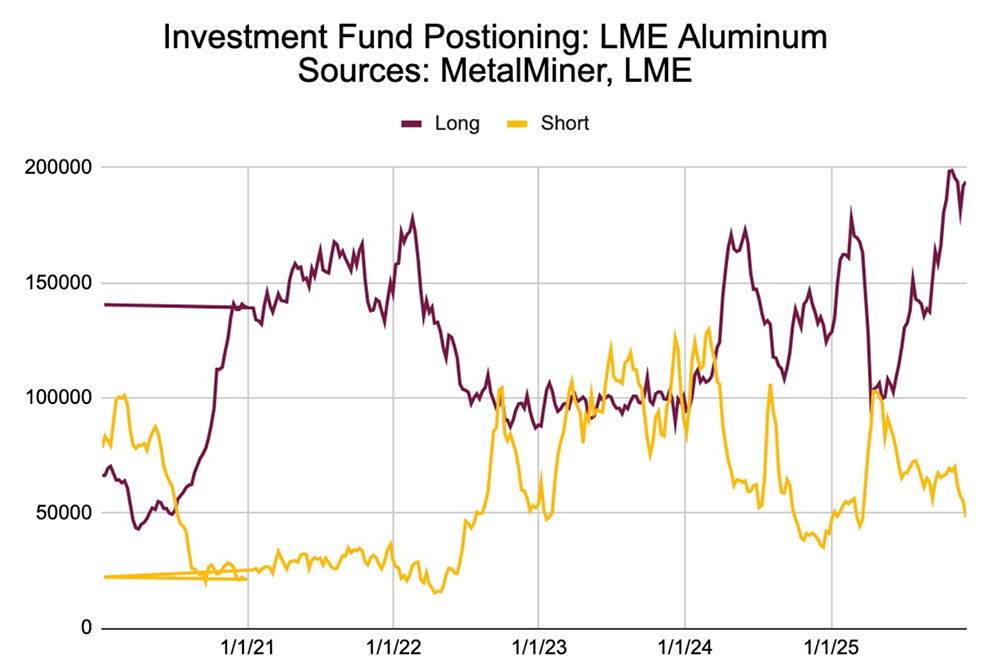
Taken together, these dynamics set the stage for aluminum prices to remain biased to the upside heading into 2026. With speculative money still committed, the market is likely to react quickly to any bullish catalyst. However, if no catalyst emerges, funds will have to contend with what appears to be a still well-supplied market and largely lackluster global demand conditions. Therefore, volatility is likely to remain elevated, with sharp swings possible.
Biggest Aluminum Price Moves
- Korean commercial 1050 sheet prices rose 4.87% to $4.11 per kilogram as of December 1.
- The premium for 3003 over 1050 Korean aluminum coil prices witnessed a 4.79% increase to $4.14 per kilogram.
- The premium for 5052 over 1050 Korean aluminum coil prices experienced a similar 4.55% rise to $4.25 per kilogram.
- Chinese primary cash aluminum prices moved sideways, with a 2.6% increase to $3,121 per metric ton.
- Indian primary cash prices saw the only decline of the overall index, falling by a modest 0.31% to $3.04 per kilogram.
